GlitchTip Compose, Celery, Postgres & Redis Fixes (8 Guides)
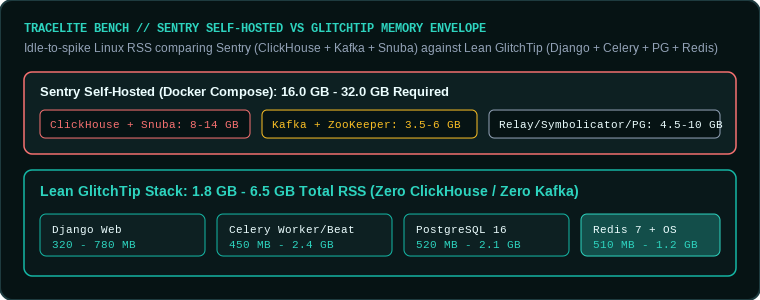
Copy-ready configuration patterns that keep GlitchTip running reliably inside 1.8 to 6.5 GB RAM across 100k to 25M monthly events.
8 Technical Triage Guides
Lean Compose Sizing
Running GlitchTip cleanly on a 2-8 GB VPS requires explicit Postgres buffer flags, Redis maxmemory, and bounded Gunicorn/Celery worker counts.
Celery Concurrency Caps
Setting CELERY_WORKER_MAX_TASKS_PER_CHILD=500 forces Python worker forks to release fragmented heap memory back to Linux automatically.
Postgres Buffers & Pruning
Sizing shared_buffers to 20-25% of host RAM and enforcing GLITCHTIP_MAX_EVENT_LIFE_DAYS keeps PostgreSQL fast on 2-8 GB NVMe VPS.
Redis maxmemory Guardrails
Setting --maxmemory with --maxmemory-policy noeviction guarantees Redis fails loudly at the edge rather than silently dropping in-flight Celery queues or starving Postgres.
Event Rate Limiting
One infinite React useEffect or retry-loop bug can fire millions of duplicate events; client-side sampling and GlitchTip project quotas stop spikes before they hit Redis.
Gunicorn Worker Bounds
Locking WEB_CONCURRENCY to 2-4 workers with --max-requests=2000 guarantees predictable web container RAM below 780 MB.
ZRAM & NVMe Swap Guard
Adding 2 GB of compressed ZRAM or NVMe swap absorbs rare 30-second deploy spikes on 2-4 GB VPS instances without kernel OOM kills.
Sentry SDK Migration
Keep every @sentry/nextjs, sentry-sdk, and sentry-go package intact—create a GlitchTip project and swap your SENTRY_DSN environment variable.